
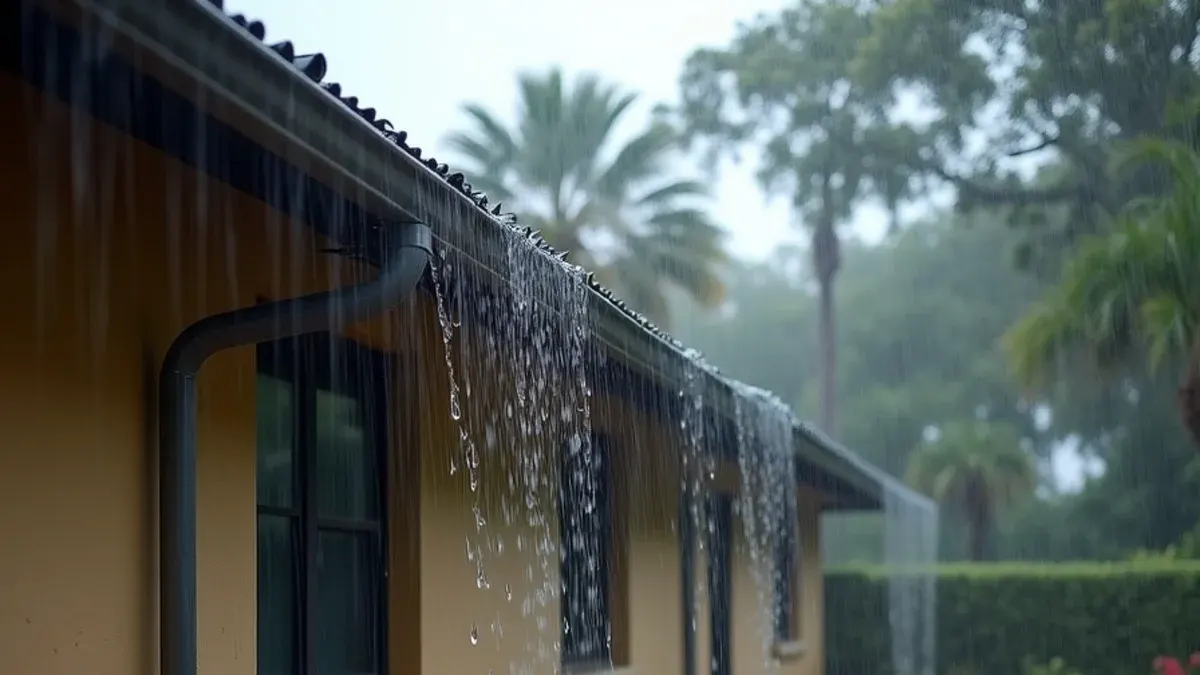
Florida does not require gutters on most homes, and plenty of houses around Vero Beach have none, or only a short run over the front door. But on the Treasure Coast, where about 53 inches of rain fall a year and much of it comes in short, heavy bursts, most homes benefit from them. Without gutters, roof water lands in a line along the house, cuts trenches in sandy soil, splashes mud onto block walls and pools at doors and garages. Some homes can do without. Many cannot.
Here is what that rain actually does, which houses are fine without gutters, and the middle ground most local homeowners land on.
Why So Many Florida Homes Have No Gutters
The Florida Building Code does not require gutters on most single-family homes. Builders across Indian River County skipped them for decades, partly to save money and partly because sandy soil drains fast and slab-on-grade homes have no basement to flood. Concrete block walls also do not rot the way wood siding does.
That logic holds up in a gentle rain. It falls apart in a wet-season storm. From June through October, afternoon cells can drop an inch or more in under an hour, and August alone averages more than 7 inches here. That is when the problems show up.
What Roof Water Does to Sandy Soil
Without gutters, every drop that hits the roof leaves at the eave in a sheet. It lands on the same strip of ground every time, called the drip line. In sandy Treasure Coast soil, that steady pounding washes the sand away and leaves a trench along the house.
- Mulch and rock wash out of beds and onto the lawn.
- Plant roots along the foundation get exposed.
- The trench channels water along the slab instead of away from it.
- Low spots hold water and breed mosquitoes after every storm.
Over the years, sand washed from under walkways and slab edges can leave voids and settling. That is slow damage, which is why people tend to blame it on something else.
Splashback, Block Walls and Stucco Staining
Water hitting the ground at speed bounces. It throws sand and soil up onto the lower two feet of the wall. On painted stucco over concrete block, that leaves a band of dirt and, in shady spots, mildew and algae. Repainting covers it for a season or two.
Block is porous. Constant splashing keeps the bottom of the wall damp, which can show up inside as peeling baseboard paint or a musty smell in closets on exterior walls. Window sills and door thresholds that sit under a long roof plane take the same soaking.
Doors, Garages, Screen Enclosures and Pavers
The places where a missing gutter hurts most are the ones you walk through:
- Front doors. Roof water dumps on your head and on guests, and soaks the threshold until the wood or trim around it rots.
- Garages. Water sheets off the eave and runs under the garage door, especially on driveways that slope toward the house.
- Screen enclosures. Roof runoff hammers the screen roof and the pool deck, and the aluminum frame can collect standing water.
- Pavers. Concentrated flow washes the joint sand out between pavers, and they start to shift and sink at the edge.
When a Home Can Honestly Do Without Gutters
Not every house needs a full system. Gutters may not be worth it if most of these are true:
- Wide roof overhangs, two feet or more, that throw water well clear of the walls.
- A lot that slopes away from the house on every side.
- Xeriscape or gravel beds at the drip line instead of mulch and turf.
- No doors, garage or lanai under the main roof edges.
- No staining, trenching or water at doors after a summer storm.
The simplest test is to walk around the house during a heavy rain. If water lands well away from the walls and drains off, you may be fine as you are.
Partial Gutters: The Common Middle Ground
A lot of Vero Beach homeowners do not gutter the whole house. They put a run over the front entry, the garage, a lanai or anywhere water causes trouble, and leave the rest alone. A partial system still needs a properly placed downspout, or it just moves the waterfall a few feet over.
If you are weighing a full or partial system, our seamless gutter installation page explains how an installer measures and forms gutters on site. For a sense of what drives the price either way, see how much gutters cost in Vero Beach.
Where the Water Goes Next: Downspouts and Discharge
Gutters collect water. Downspouts decide where it ends up. A common guideline is to discharge at least 3 feet from the building, and on sandy lots farther is often better. Extensions, splash blocks or an underground drain line can carry water to the yard or a swale. Our downspouts and drainage page covers the options.
Where the water lands matters beyond your yard, too. Runoff from the area drains toward the Indian River Lagoon, and Indian River County runs a stormwater program for that reason. Sending roof water into a lawn or bed, where it can soak in, is better than piping it straight to the street.
Putting up a gutter only finishes the first half of the job. The U.S. Environmental Protection Agency's stormwater guidance makes the point plainly: when rain falls on a roof or a slab instead of open ground, more of it runs off, faster, which means more erosion, more localized flooding and more pollutants riding along to the nearest drain. A gutter gathers that runoff into a few strong streams. Good stormwater runoff gutter solutions decide where each stream lands, so it soaks into the yard instead of scouring a bed or racing down the driveway.
Why a new gutter can still spill over
Homeowners who add gutters after years without them are sometimes surprised to see water pouring over the edge in the first big storm. The usual causes:
- Clogged outlets. A wad of oak leaves or pine needles at the downspout opening backs up the whole run.
- Poor pitch. If the slope toward the outlet is too flat, or runs the wrong way, water sits and spills at the low spot.
- Valley flow. Where two roof planes meet, the valley pours a concentrated stream that can jump straight over a corner.
- Undersized gutters. A 5-inch gutter under a large tile or metal roof fills faster than it drains.
- Too few downspouts. One outlet serving a long run cannot keep up with a summer cloudburst.
The same applies just over the county line. On level lots in Lakewood Park, homes without gutters often show trenching and ponding near entries, and a short run with a well-placed downspout usually fixes it.
Common questions
Are gutters required by code in Florida?
On most single-family homes, no. The Florida Building Code does not generally require gutters, which is why so many houses in Indian River County were built without them. An HOA may have its own rules about gutters, colors or downspout placement, so check your community documents. Even where nothing requires them, gutters are often the simplest way to keep roof water away from doors, walls and the foundation.
Why do so many Florida houses not have gutters?
Builders skipped them for decades to save cost, and the reasoning seemed sound: sandy soil drains fast, homes sit on slabs without basements, and concrete block does not rot. That holds up in light rain. It does not hold up in a wet-season downpour, when roof water trenches the drip line, splashes mud on walls and floods entries. That is why so many owners add gutters later.
Can I just put gutters over the front door?
Yes, and it is one of the most common jobs around Vero Beach. A short run over the entry, the garage or a lanai handles the spots where roof water causes the most trouble. Make sure it has a downspout that discharges away from the walkway, ideally at least 3 feet from the house. A partial system can always be extended later if other areas start to show trenching or staining.
Can adding gutters make drainage worse on a sandy Florida lot?
It can if the downspouts are placed badly. Without gutters, roof water spreads along the whole drip line. With them, the same water leaves through a few outlets, and a downspout that empties beside the slab or onto a paver walk can dig a deeper hole than the drip line ever did. Run each downspout to a spot that drains, at least 3 feet out, and check it during the first heavy storm.
Your next step
Florida leaves the decision to you. If you see trenches at the drip line, stained walls or water at the door after a storm, the house is telling you it needs gutters, at least in a few places. Call (855) 633-0442 and we will connect you with a local installer who can look at your roofline and recommend a full or partial system.