
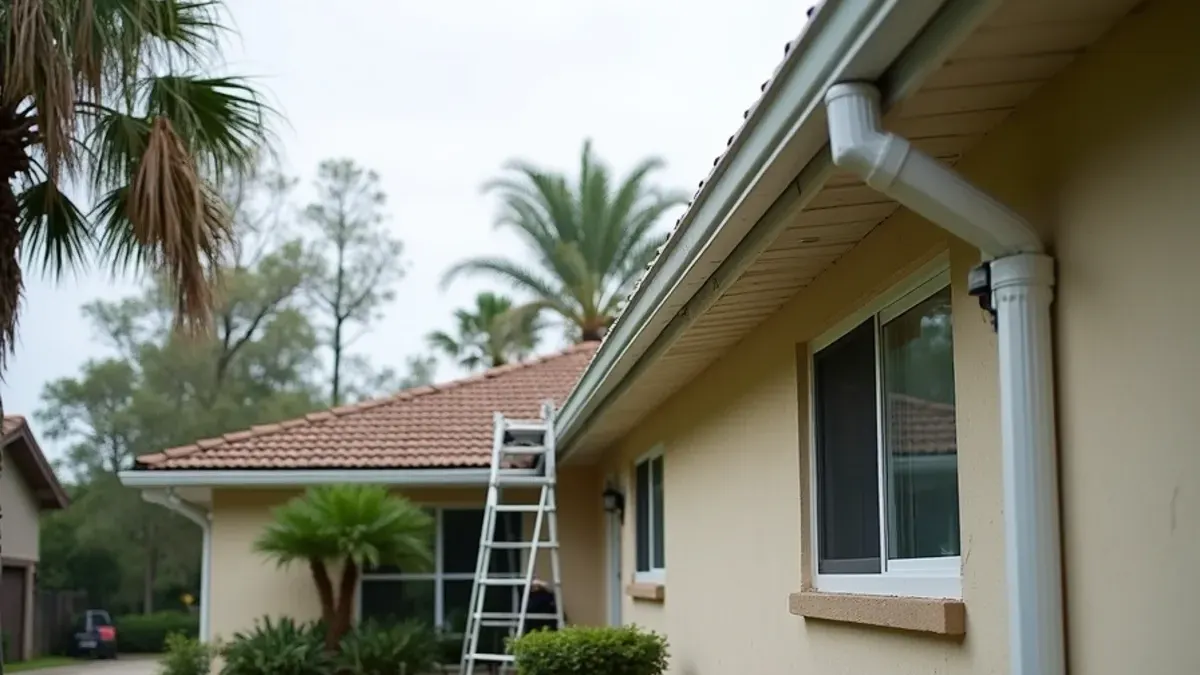
If wind has torn gutters off your house, stay off the ladder until the weather has fully passed, keep everyone away from sections hanging over doors and walkways, and photograph the damage before you move a single piece. Those dated photos and videos are the first thing an insurance adjuster asks for, along with the date of loss and a written repair estimate. Set fallen sections aside instead of hauling them to the curb, and have an installer check the fascia behind the gutter, because that board often takes the real damage.
Treasure Coast homeowners have done this before: Frances and Jeanne in 2004, and the October 9, 2024 tornado outbreak during Hurricane Milton, when an EF3 tracked 21 miles from Port St. Lucie past Fort Pierce toward Vero Beach. Here is the order that keeps you safe and your paperwork clean.
Safety First: The Hour After the Wind Drops
A loose gutter is a long, sharp lever, and the last hanger holding it may be down to one stripped screw. Wait it out from inside.
- Stay off ladders while wind is still gusting.
- Look up before stepping out the front door or opening the garage. Sections often fold down over entries.
- Check for downed power and cable lines before going near any gutter.
- Keep children and pets clear. Torn aluminum edges cut.
Document the Damage Before Anything Is Moved
Your phone stamps every photo with a date and time. Take more pictures than you think you need, because nobody can inspect what has already been cleaned up.
- Wide shots of every side of the house, showing where gutters are missing or sagging.
- Close-ups of torn hangers, pulled screws, split corner joints and crushed downspouts.
- The fallen sections exactly where they landed, with the house in the frame if you can.
- The fascia, the board the gutter hangs on, anywhere the gutter pulled away from it.
- Any water stains on soffits, ceilings or interior walls near the eaves.
- A slow video walk-around where you say the date and describe what you see.
Back the files up the same day. Older photos of the house, such as listing photos, help show what the gutters looked like before the storm.
Photo and video inventory to print or screenshot
| Item | What to capture |
|---|---|
| Overflow | Dirt lines, washed mulch or a wet wall below a run |
| Clogged outlets | Debris packed at the downspout opening, before anyone clears it |
| Fascia separation | The gap between gutter and board, with a tape measure in the shot |
| Corrosion | Rusty screws, hangers or seams, close up |
| Water paths | Soffit and wall stains, and channels in the sand |
| Loose hangers | Hangers bent, pulled or hanging free |
| Storm impact | Dents, branch strikes and debris on the roof edge |
Temporary Measures That Keep Your Options Open
Once the photos are done, make the house safe without throwing away evidence.
- Drag fallen sections off the driveway and walkways and lay them along a side yard. Do not put them out for bulk pickup.
- Keep a sample piece. It shows the size, profile and color for matching a repair.
- Keep receipts for tarps, fasteners or anything else you buy for temporary repairs.
- Do not sign a full replacement contract on the spot with someone who knocked on your door.
After big storms, out-of-area crews show up asking for deposits. Verify any contractor at the Florida DBPR license search on myfloridalicense.com and ask whether the county requires a permit for the work. Every gutter installer we send is licensed where Florida requires it, and insured.
Hurricane Deductibles and What Insurers Commonly Ask For
Florida homeowners policies often carry a separate hurricane deductible alongside the regular one, and it is frequently written as a percentage of the dwelling coverage rather than a flat number. Which deductible applies to a particular storm, and whether gutter damage is covered at all, depends on your policy and is decided by your insurer. Check your declarations page, the summary sheet at the front of the policy, and ask your agent if the wording is unclear.
What adjusters commonly ask for
- The date of loss, meaning the day the storm hit.
- Dated photos and video of the damage before cleanup.
- A written, itemized repair estimate from an installer.
- Receipts for any temporary repairs or materials.
- Access to the fallen sections, if you kept them.
Questions to put to your insurer before repairs start
The installer can document the visible gutter and fascia damage. The claim rules come from your insurer, so ask, and note who you spoke with:
- What temporary steps should I take to prevent more damage, and how do I record them?
- Do you need specific photos before anything is moved?
- Does an adjuster need to inspect the gutters before the installer starts work?
Repair or Replace: How an Installer Decides
Not every storm-damaged gutter needs to come down. The question is whether the metal is damaged or only its fastening failed.
| What the installer finds | Usual approach | Why |
|---|---|---|
| Section dropped, metal still straight | Rehang with new hidden hangers | The gutter is fine; only the fasteners failed |
| Run kinked or creased | Replace that run | Creased aluminum will not hold pitch and leaks at the fold |
| Corner joints (miters) split | Reseal or replace the miter | Corners take the most twist when wind gets under a gutter |
| Most of one side torn away | Replace that side or the whole system | Patching a long run creates seams that leak |
| Downspouts crushed or loose | Replace sections and straps | Downspout parts swap out easily |
Most gutters here are seamless, formed on site from aluminum coil, so a badly damaged run is usually remade in one piece rather than spliced. Our storm gutter repair page explains the process.
Storm damage and old wear belong on separate lines
Many storm-torn gutters were already struggling. Ask the installer to keep two lists in the written condition notes: what the wind did, such as a torn-loose run or a twisted miter, and what was there before, such as rusted fasteners, a packed outlet, soft fascia or lost pitch. Kept apart, they give your insurer a clean picture of the storm part.
Check the Fascia Behind the Gutter
When wind pries a gutter off, the screws tear out of the fascia. The median Vero Beach home was built around 1976, so that board may already be soft from years of overflow. A new gutter on rotten wood is the next failure waiting.
- Screw holes that are torn, oval or stripped.
- Dark staining or soft spots when you press with a screwdriver.
- Aluminum fascia wrap bent away from the wood behind it.
- A gap between the fascia and the roof edge.
Fascia repair should be its own line on the estimate, which keeps the insurance paperwork clear.
Storm Repairs in Fort Pierce, Lakewood Park and Vero Beach
The 2024 EF3 crossed St. Lucie County first. If you need storm gutter repair in Fort Pierce or gutter repair in Lakewood Park, remember St. Lucie County has its own contractor and permit rules, separate from Indian River County. Ask the installer which apply to your address.
On the barrier island, ask for stainless or coated fasteners. Salt air rusts plain steel screws, and a rusted screw lets go first.
After a widespread storm, every installer on the coast is booked at once, so nobody can promise a fixed window. Ask early for a gutter inspection after the storm in Vero Beach or nearby, let your photos hold the evidence, and we will tell you the earliest available visit.
Common questions
Should I throw away gutters that blew off in a storm?
No, keep them until your claim is settled or you decide not to file one. Fallen sections show the gutter size, profile, color and hanger type, and an adjuster may want to see them. Photograph them where they landed, move them to a side yard, and keep at least one sample piece after the rest is hauled off so the installer can match a partial repair.
Does homeowners insurance cover storm damaged gutters in Florida?
That depends entirely on your policy, and only your insurer can answer it. Florida policies often carry a separate hurricane deductible, and which deductible applies can depend on the type of storm. Read your declarations page and call your agent with specific questions. What you can control is the paperwork: dated photos taken before cleanup, the date of loss, receipts for temporary repairs and a written, itemized estimate from an installer.
Can I reattach a fallen gutter myself?
A homeowner can sometimes rehang a short section on a single-story house, but storm damage usually involves more than it appears. Hangers tear out of the fascia, corner joints twist open and the gutter loses its pitch, the slight slope that moves water to the downspout. If the fascia is soft, new screws will not hold. Take your photos first, then have an installer assess the fascia and pitch before anything goes back up.
Will the installer's estimate say the storm caused the gutter damage?
It will describe what the installer saw, not rule on your claim. A careful estimate lists fresh damage, such as torn screw holes and twisted corners, apart from older rust or soft fascia. Deciding what counts as storm loss is your insurer's call. Pair the estimate with your own dated photos from before cleanup.
Your next step
The order is simple: safety, photos, keep the pieces, then a written estimate. Once the area is safe and documented, call (855) 633-0442 and we will match you with a local installer who can assess the gutters and fascia and tell you the earliest available visit.