
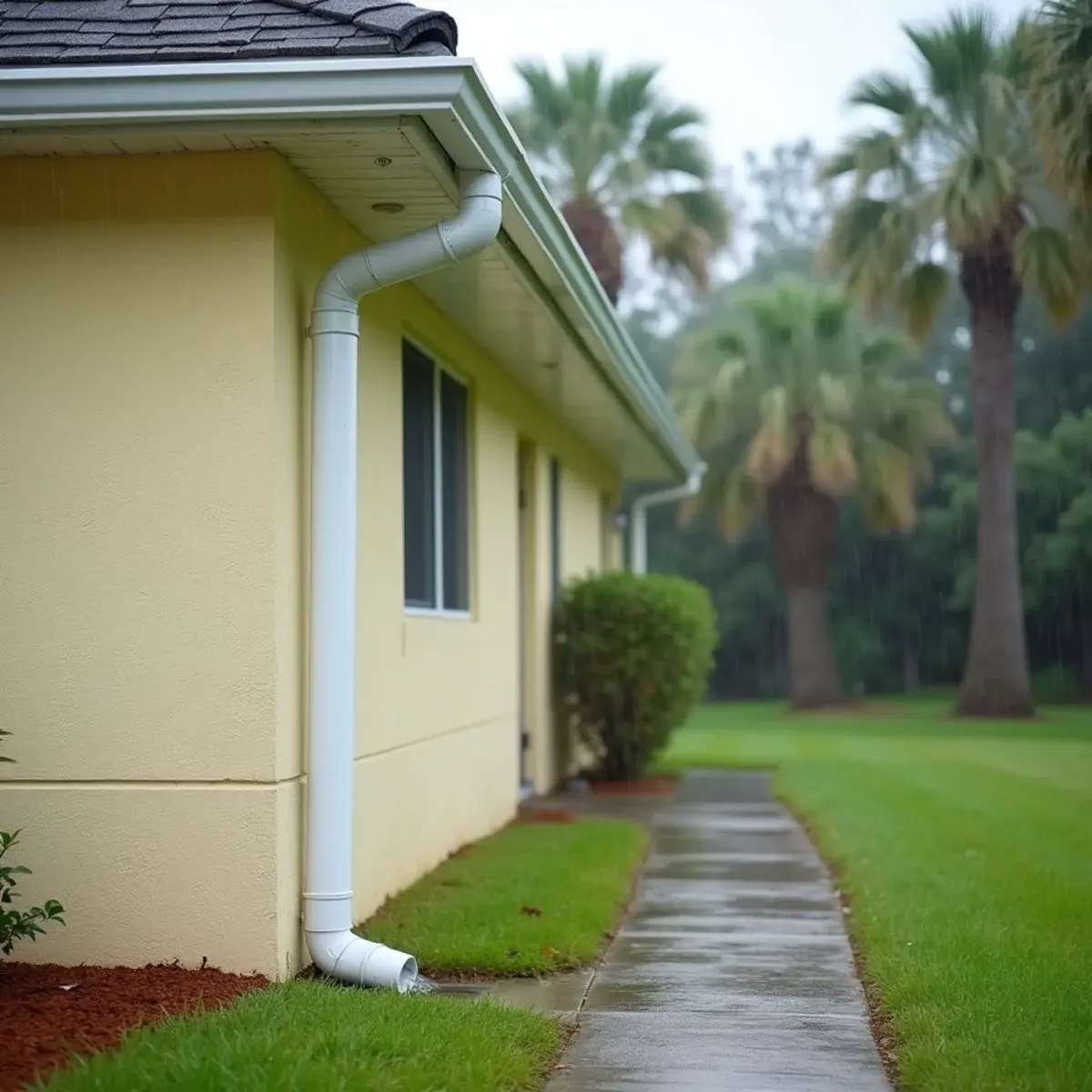
Most drainage trouble on a Vero Beach property shows up on the ground long before anyone looks at the roof. Call (855) 633-0442 and we will connect you with a local installer who checks where your downspouts empty now and where that water ought to go instead.
The land here is flat and the soil is mostly sand. Sand drains fast but moves easily, so a downspout pouring into one spot digs a hole there every summer, and water nobody carries away tends to sit against the slab. On this coast, the downspout is often the half of the gutter system that needs more thought.
Signs roof water is not getting away from the house
Walk around the house the morning after a heavy rain and look for patterns:
- A trench or bare strip in the sand along the drip line (where water falls off the roof edge).
- Mulch and river rock washed out of the beds.
- Standing water against the slab or where the driveway meets the house.
- Pavers sunk or tilted near a downspout.
- Mildew or peeling paint low on the block walls.
- Corners that overflow even when the gutters are clean, a sign of too few or too small downspouts.
A downspout-by-downspout drainage review
- Follow every downspout to where its water actually lands, including any that disappear underground.
- At each release point, look for splashback, standing water, washed-out sand and staining along the slab edge.
- Check that the extension or splash block is still attached, long enough and pointed downhill.
- Before burying a line or turning one toward a swale, the street or a neighbor, check how the lot drains and whether a permit applies.
- Write the final discharge direction for each downspout into the scope.
Downspout sizing: 2x3 vs 3x4 for Florida rainfall
Residential downspouts come in two common sizes, named for their width and depth in inches. In a summer cloudburst the downspout opening, not the gutter, is often the bottleneck.
| 2x3 downspout | 3x4 downspout | |
|---|---|---|
| Capacity | Lower | About twice the opening of a 2x3 |
| Usual pairing | 5-inch K-style gutter | 6- and 7-inch K-style gutters |
| Clogging | Plugs sooner with tassels and seed pods | Passes debris more easily |
| Best use | Porches and small roof areas | Main runs and steep tile roofs |
Count matters as much as size. A long run with one outlet at the far end makes all the water travel the full length first. A second downspout midway often cures overflow more cheaply than a bigger gutter. If the gutters are being replaced too, plan both together as part of seamless gutter installation.
Where downspouts should discharge on a flat, sandy lot
A common guideline is to release downspout water at least 3 feet from the building. On sandy lots with little slope, farther is usually better. A good discharge point:
- Sits on ground that falls away from the house, even slightly.
- Lands on lawn or planting that can absorb it, not bare sand.
- Keeps water off a neighbor's lot and the sidewalk.
- Stays clear of the A/C pad, pool equipment and any septic drainfield.
Many 1970s homes in Vero Beach South and Florida Ridge have a single short gutter over the front door, dumping beside the step. Moving that one outlet a few feet can end a problem the owner has lived with for years.
Extensions, splash blocks and buried drain lines with pop-up emitters
Splash blocks
A concrete or plastic trough that spreads the stream so it does not bore a hole in the sand. Cheap, but it moves water only a short way.
Downspout extensions
Extra downspout or a hinged flip-up section carrying water several feet out. Hinged ones lift for mowing, though lawn crews still knock them loose.
Buried drain lines with pop-up emitters
The downspout feeds a solid pipe a few inches under the lawn, ending at a spring-loaded emitter that opens when water arrives. It is the tidiest underground downspout drain and can carry water well past the beds.
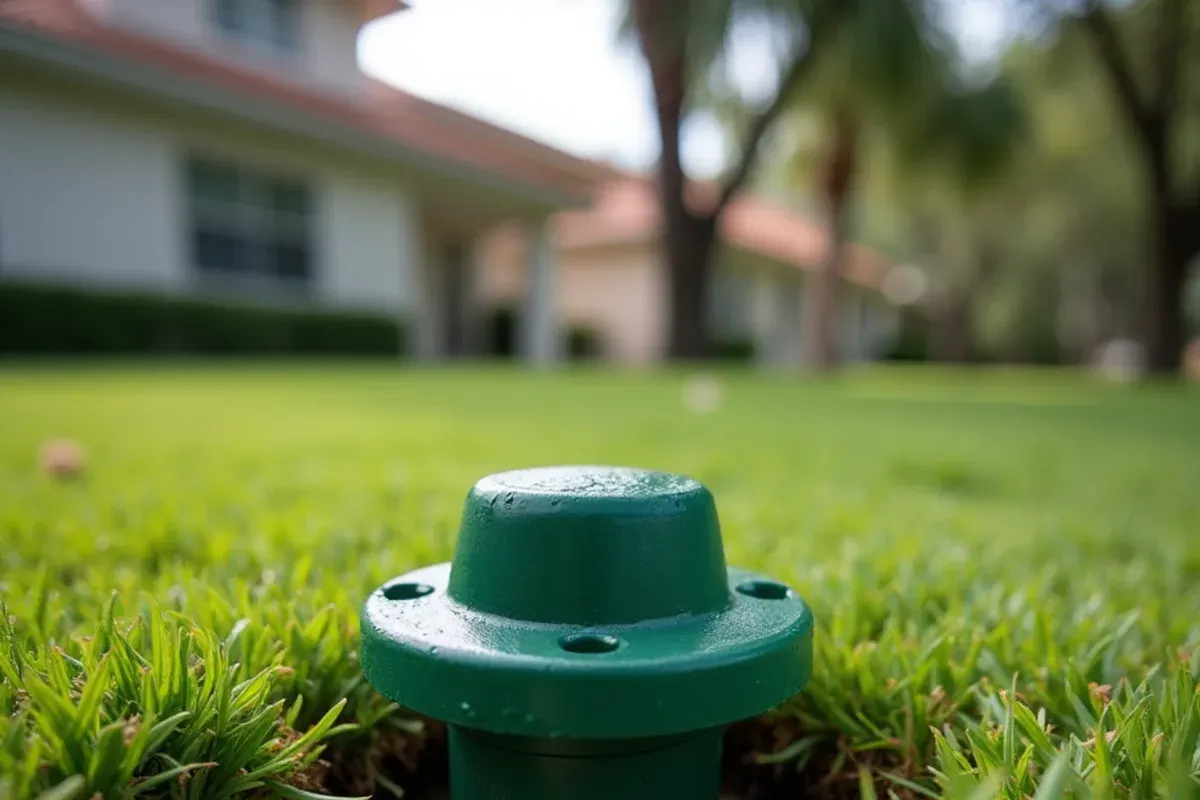
Sand is forgiving to trench, and a line laid with steady fall drains well. The risks are roots in the joints and silt or roof grit settling at low spots, which is why smooth-walled pipe beats corrugated tubing where possible.
Protecting pavers, pool decks and screen enclosures from runoff
Pavers sit on sand. Pour concentrated roof water on one spot and the sand washes out from under them, which is why pavers by a downspout sink first. A buried line that releases beyond the paver edge prevents most of it.
Around a pool, runoff carries sand and needles into the water or collects against the house. Where a screen enclosure attaches to the fascia, its downspout usually runs down an enclosure post and out under the deck. If the enclosure frame is pulling on the gutter, that is also a gutter repair job worth handling on the same visit.
Erosion at the drip line: what it does to landscaping and the slab edge
Without working gutters, water sheets off the roof edge and lands in a straight line a foot or two out. In sand, that line becomes a trench. Shrubs lose soil around their roots and mulch ends up on the driveway.
Worse, constant soaking beside the slab can expose its edge over time, and splash-back throws dirt onto the lower stucco. Our article on whether Florida homes need gutters shows what Treasure Coast rain does to a house without them.
Rain chains and rain barrels: where they fit
Rain chains guide water down a string of cups in place of a downspout. They suit an entry or courtyard, but in a cloudburst they splash and spill far more than a closed downspout, so keep them to small roof areas with a gravel basin below.
Rain barrels fill quickly here. Each needs an overflow hose and a tight screen, since an open barrel breeds mosquitoes.
Where runoff ends up matters beyond your yard. Water that crosses fertilized lawns and driveways reaches storm drains, and here those drains lead toward the Indian River Lagoon. Indian River County manages that runoff through its NPDES Phase II stormwater program. Sending downspouts into lawn and beds rather than onto pavement is a small, practical help.
Stormwater runoff and the Indian River Lagoon
The U.S. Environmental Protection Agency notes that roofs, driveways and other hard surfaces shed rain faster than open ground, adding to erosion and flooding and carrying fertilizer, grit and other pollutants with the water. Its NPDES stormwater program is the federal framework behind permits like Indian River County's Phase II program.
Questions about swales, ditches and street drains go to the City of Vero Beach inside city limits and to Indian River County elsewhere. Ask before a buried line is tied into a swale.
Drainage-sensitive neighborhoods, North River Shores among them, deserve extra care. Where a yard already holds water after a storm, the better downspout drainage solution is usually a longer run to the best-draining part of the lot.
What affects downspout and drainage cost
We do not publish prices. The cost moves with:
- Number of downspouts and any new outlets cut into the gutters.
- Size (3x4 uses more material than 2x3) and wall height.
- Buried line length, emitters, cleanouts, and pavers or sod to lift and relay.
- Routing around enclosures, pool equipment and A/C pads.
- Repairs found along the way, such as crushed elbows or rotted fascia.
- Permits, where they apply.
Your installer gives you a written price before work starts. Installers we work with cover downspout work in Sebastian, older homes in Fort Pierce and every town on our Vero Beach service areas page.
Downspouts & Drainage questions from Vero Beach homeowners
How far from the house should a downspout discharge?
A common guideline is at least 3 feet from the building, and on the flat, sandy lots around Vero Beach, farther is often better. Release the water on ground that slopes away from the slab and can absorb it, such as lawn or a planted bed. Avoid paver edges, the A/C pad, a neighbor's yard and any septic drainfield. Where an extension would be in the way, a buried line can carry water out.
Can downspouts be piped underground in sandy soil?
Yes. Sand is easy to trench and drains well around a properly laid pipe. The line needs a steady downhill fall, smooth-walled pipe where practical, and a pop-up emitter out in open lawn. Roots, silt and roof debris are the main threats, so ask for a cleanout at the top of each line. Clean or guarded gutters keep a buried pipe clear much longer.
How many downspouts does my house need?
There is no fixed number; it depends on roof area, pitch, gutter size and run length. Every separate run needs at least one outlet, and long runs on large or steep roofs usually need one at each end or one in the middle. If gutters overflow at the corners even when clean, the house likely needs more or larger downspouts. The installer works out the count while measuring.
Why does water pool next to my foundation after every storm?
Usually because roof water lands too close to the house and the flat lot gives it nowhere to go. Common causes are missing gutters, a downspout emptying at the wall, a loose or crushed extension, a clogged buried line, or soil sloping toward the slab. Watch where each downspout releases during a rain. Extending or rerouting them often fixes the pooling without regrading.
Can fixing my gutters and downspouts stop water from washing out my landscaping?
Usually, yes, if the fix covers where the water lands and not just the gutter. Resealing a leaking corner or replacing a crushed elbow stops the splash at the wall, but a downspout that still empties into the same bed keeps washing the sand away. Pair the repair with an extension or buried line that releases water past the planting, then replace soil and mulch after one heavy rain.
Do I need approval to bury a downspout line or send it toward the street?
It depends on your address and where the water ends up. A short line that releases on your own lawn rarely raises questions. Tying into a swale, storm drain or ditch, or sending water onto a neighbor's lot, can fall under city or county drainage rules. Your installer should note in the written scope who checks what applies.
Does where my downspouts drain really matter for the Indian River Lagoon?
In a small way, yes. Roof water that runs over a fertilized lawn edge or a driveway carries nutrients and grit to storm drains, many of which lead toward the lagoon. Water released onto lawn or a planted bed mostly soaks into the sand instead, which makes re-aiming a downspout one of the simplest changes a homeowner can make.
Last reviewed . We review this page before each rainy season and when code, licensing or county guidance changes.